Current Research Projects
CAREER: Sparse Graph-Based Codes for Network Data Compression
Radiation-Hardened Microelectronics Workforce Development Consortium
Previous Research Projects (5)
RINGS: Resilient Edge Ecosystem for Collaborative and Trustworthy Disaster Response
CREST: Interdisciplinary Center for Research Excellence in Design of Intelligent Technologies for Smartgrids Phase II
RII Track-1: The New Mexico SMART Grid Center: Sustainable, Modular, Adaptive, Resilient, and Transactive
CCSS: Coding for 5G and Beyond: Limits and Efficient Algorithms
Hybrid UWB/Optical Communications for Distributed Space Systems
Project Highlights
Quantum Error Correction
Quantum computers promise to solve certain problems far faster than any supercomputer, but the fragile quantum states they rely on are easily disturbed by noise. Small errors build up quickly and can derail a computation entirely. This project develops new quantum error correcting codes and better decoding algorithms so that quantum computers can keep working reliably even as they scale up.
The group's quantum LDPC and quantum convolutional code designs, along with new decoding techniques including soft-hard decimation and reinforcement-learning-based decoders, outperform existing decoders across a range of noise levels, moving quantum hardware closer to reliable, fault tolerant operation.
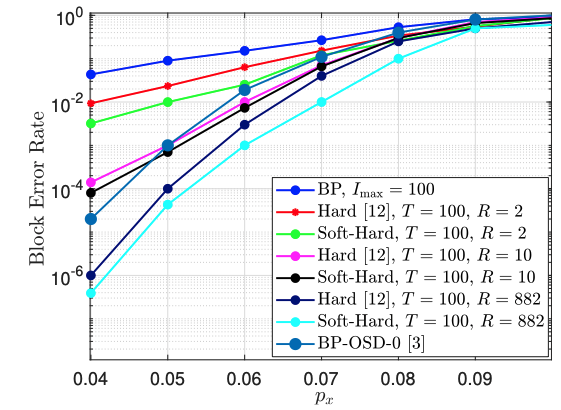
- V. Nourozi, T. Koike-Akino, and D. G. M. Mitchell, "Reinforcement-Learning-Guided Multi-Branch Decoding of Quantum LDPC Codes," Proc. IEEE International Conference on Quantum Computing and Engineering, Toronto, Canada, Sept. 2026.
- M. Moradi, V. Nourozi, T. Kim, R. A. Chou, and D. G. M. Mitchell, "High-Performance Reinforcement-Learned Belief-Propagation Decoding of Quantum LDPC Codes," Proc. IEEE International Conference on Quantum Computing and Engineering, Toronto, Canada, Sept. 2026.
- V. Nourozi and D. G. M. Mitchell, "Constructing Quantum Convolutional Codes via Difference Triangle Sets," Proc. IEEE International Conference on Communications, Glasgow, UK, pp. 1-6, May 2026.
- V. Nourozi and D. G. M. Mitchell, "Quantum Convolutional Codes Constructed from Classical Self-Orthogonal Convolutional Codes," Proc. IEEE International Conference on Quantum Computing and Engineering, Albuquerque, NM, Sept. 2025.
- M. Alinia, D. G. M. Mitchell, H. Yao, and H. D. Pfister, "Decimation Strategies for Belief Propagation Decoding of Quantum LDPC Codes," Proc. International Symposium on Topics in Coding, Los Angeles, CA, Aug. 2025.
Coded Discrete Variational Autoencoders (Coded-DVAEs)
AI tools that generate text, images, or audio, like large language models and diffusion based art generators, are usually overconfident: they report high certainty in their outputs even when they're wrong. This project asks whether ideas from error correcting codes, the same math used to keep data reliable on hard drives and over wireless links, can make these generative AI models both better at their core task and more honest about what they don't know.
Building redundancy borrowed from coding theory into a generative model's internal representation improved both the quality of its generated output and, critically, gave uncertainty estimates that better reflect the model's actual confidence, a step toward AI systems that know, and can communicate, the limits of what they know.

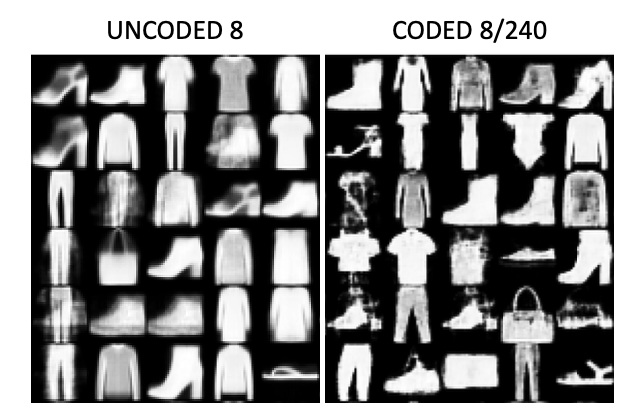
- M. Martínez-García, G. Villacrés, D. Mitchell, P. M. Olmos, "Improved Variational Inference in Discrete VAEs using Error Correcting Codes," Proc. Conference on Uncertainty in Artificial Intelligence, Rio de Janeiro, Brazil, July 2025.
Machine Learning Techniques for 6G Communication Systems
Future 6G wireless networks will need extremely fast, extremely reliable communication for things like remote surgery and autonomous vehicles. This project uses reinforcement learning to speed up the decoders that correct transmission errors, teaching them to process the right pieces of data in the right order rather than a fixed sequence. It also looks at how machine learning models running on connected devices can be trained to tolerate noisy, error prone wireless links directly, instead of relying only on traditional error correction hardware.
The reinforcement learning approach sped up decoder convergence by 30 to 50 percent, directly cutting latency and power use in next generation wireless hardware. The companion technique for training AI models to tolerate channel noise cut power consumption by roughly 30 percent in IoT systems, an important gain for battery powered sensors and devices.

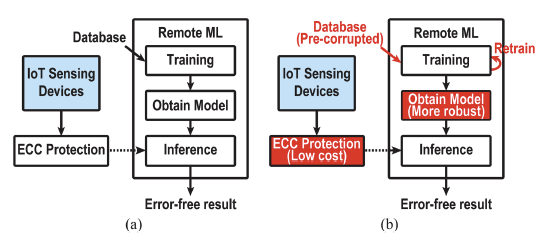
- M. Moradi*, S. Habib*, and D. G. M. Mitchell, "Enhancing Belief Propagation Decoding of Polar Codes: A Reinforcement Learning Approach," IEEE Communications Letters, vol. 29, no. 6, pp. 1285-1289, June 2025.
- H. Hatami, D. G. M. Mitchell, D. J. Costello, Jr., and T. E. Fuja, "Threshold-based min-sum algorithm to lower the error floors of quantized low-density parity-check decoders," U.S. Patent No. 12,334,954 B1, issued June 17, 2025.
- S. Habib* and D. G. M. Mitchell, "Reinforcement Learning for Sequential Decoding of Generalized LDPC Codes," Proc. International Symposium on Topics in Coding, pp. 1-5, Brest, France, Sept. 2023.
- X. Tang, P. Reviriego, W. Tang, D. G. M. Mitchell, F. Lombardi, and S. Liu, "Joint Learning and Channel Coding for Error-Tolerant IoT Systems based on Machine Learning," IEEE Transactions on Artificial Intelligence, vol. 5, no. 1, pp. 217-228, Jan. 2024.
Spatially Coupled LDPC (SC-LDPC) Codes
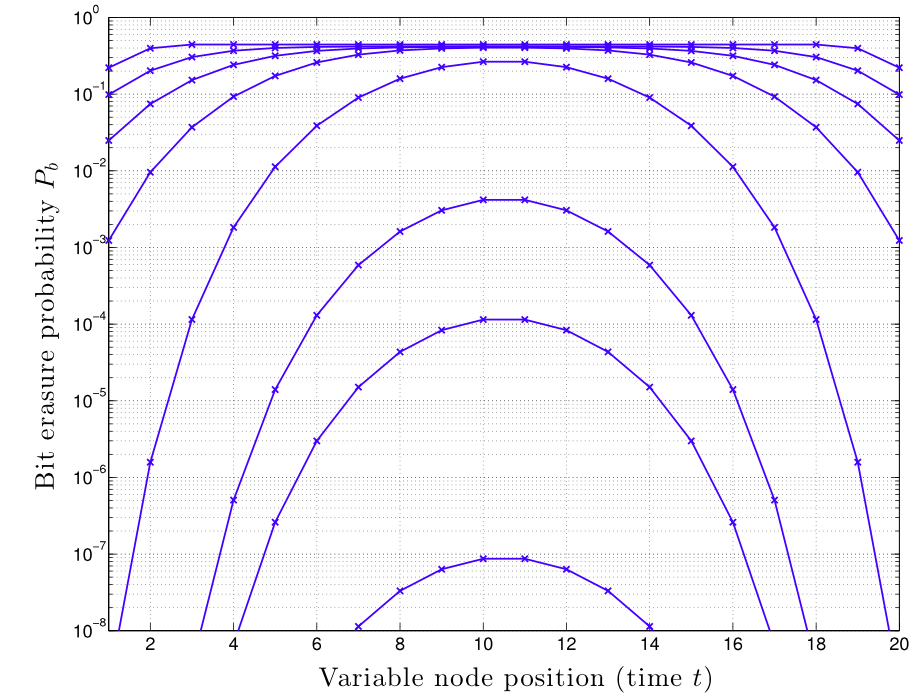
Many modern error correcting codes trade off between decoding easily and getting close to the theoretical performance limit. This project showed that chaining together many small, identical coding structures into one long connected code, called spatial coupling, lets simple iterative decoders reach performance very close to that theoretical limit. The resulting codes also correct errors in a distinctive wave like pattern, with reliability spreading in from the ends of the chain toward the center as the decoder runs.
This work established spatially coupled codes as a practical way to get near optimal performance with low complexity decoding, and the approach has since been adopted well beyond communications, including in compressed sensing, quantum codes, and statistical physics.
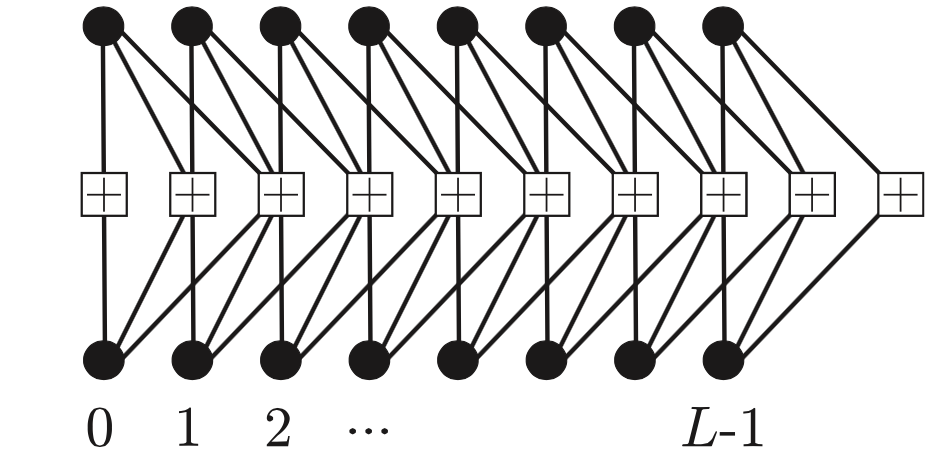
- D. G. M. Mitchell, M. Lentmaier, and D. J. Costello, Jr., "Spatially Coupled LDPC Codes Constructed from Protographs," IEEE Transactions on Information Theory, vol. 61, no. 9, pp. 4866-4889, Sep. 2015.
- D. G. M. Mitchell, P. M. Olmos, M. Lentmaier, and D. J. Costello, Jr., "Generalized Spatially-Coupled LDPC Codes: Asymptotic Analysis and Finite Length Scaling," IEEE Transactions on Information Theory, vol. 67, no. 6, pp. 3708-3723, June 2021.
- M. Zhu, D. G. M. Mitchell, M. Lentmaier, and D. J. Costello, Jr., "Error Propagation Mitigation in Sliding Window Decoding of Spatially Coupled LDPC Codes," IEEE Journal on Selected Areas in Information Theory, vol. 4, pp. 470-486, 2023.
- K. Huang, D. G. M. Mitchell, L. Wei, X. Ma, and D. J. Costello, Jr., "Performance Comparison of LDPC Block and Spatially Coupled Codes over GF(q)," IEEE Transactions on Communications, vol. 63, no. 3, pp. 592-604, Mar. 2015.
Lossy Source Coding
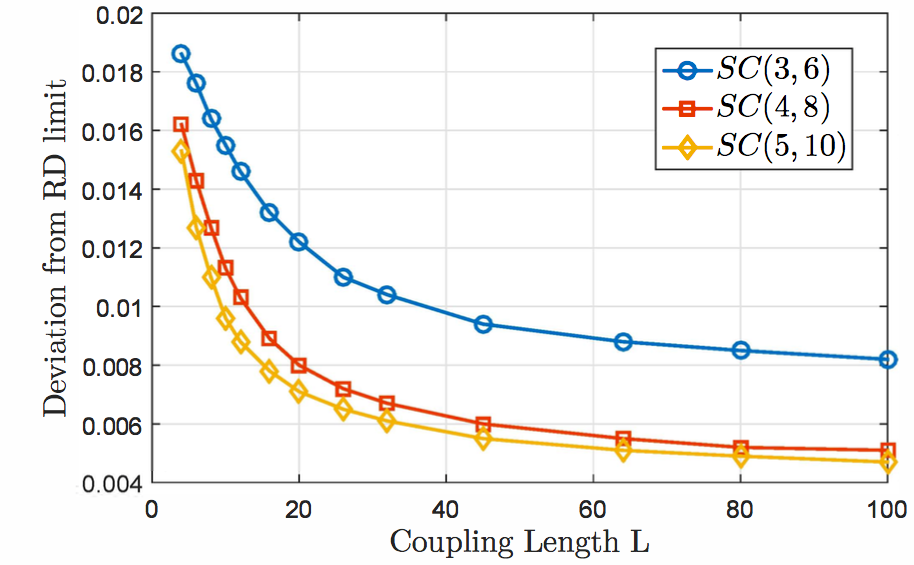
Compressing speech, audio, and video always involves some loss of information, and the goal is to lose as little quality as possible for a given amount of compression. This project applies spatially coupled coding structures, originally developed for correcting transmission errors, to the compression problem itself, showing that these codes can compress data almost as efficiently as the theoretical best possible, with practical encoding delay.
The resulting codes close much of the gap to the theoretical compression limit and outperform existing joint source and channel coding schemes with comparable complexity and delay, useful wherever data must be both compressed and protected against transmission errors.
- A. Golmohammadi* and D. G. M. Mitchell, "Concatenated Spatially Coupled LDPC Codes with Sliding Window Decoding for Joint Source-Channel Coding," IEEE Transactions on Communications, vol. 70, no. 2, pp. 851-864, Feb. 2022.
- A. Golmohammadi*, D. G. M. Mitchell, J. Kliewer, and Daniel J. Costello, Jr., "Encoding of Spatially Coupled LDGM Codes for Lossy Source Compression," IEEE Transactions on Communications, vol. 66, no. 11, pp. 5691-5703, Nov. 2018.
Generalized Codes for Ultra-reliable Low-Latency Communication
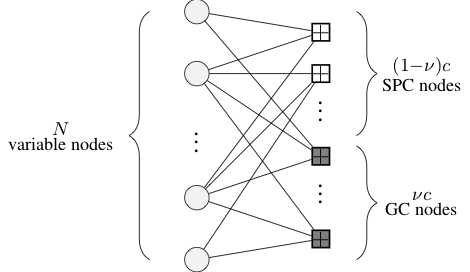
5G and future wireless networks need to support use cases, like industrial automation and vehicle to vehicle safety systems, that demand both very low error rates and very low delay. This project designs generalized low density parity check codes, which replace simple parity checks with stronger error correcting building blocks, tailored specifically for these ultra reliable, low latency requirements.
The resulting codes outperform a range of state of the art alternatives at the block lengths and code rates relevant to 5G URLLC, giving network designers a practical path to meeting these strict reliability and latency targets.
- P. M. Olmos, Y. Liu*, and D. G. M. Mitchell, "Low-density Parity-check (LDPC) Codes for 5G Communications," Wiley 5G Ref: The Essential 5G Reference Online, Wiley & Sons, Jan. 2021.
- Y. Liu*, P. M. Olmos, and D. G. M. Mitchell, "Generalized LDPC codes for Ultra Reliable Low Latency Communication in 5G and Beyond," IEEE Access, vol. 6, no. 1, pp. 72002-72014, Dec. 2018.
- R. Smarandache and D. G. M. Mitchell, "A Unifying Framework to Construct QC-LDPC Tanner Graphs of Desired Girth," IEEE Transactions on Information Theory, vol. 68, no. 9, pp. 5802-5822, Sept. 2022.
Low-Complexity Hardware Implementation of Codes
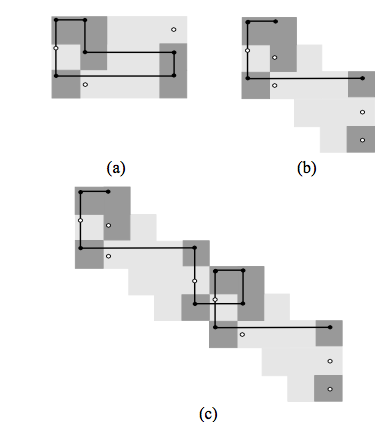
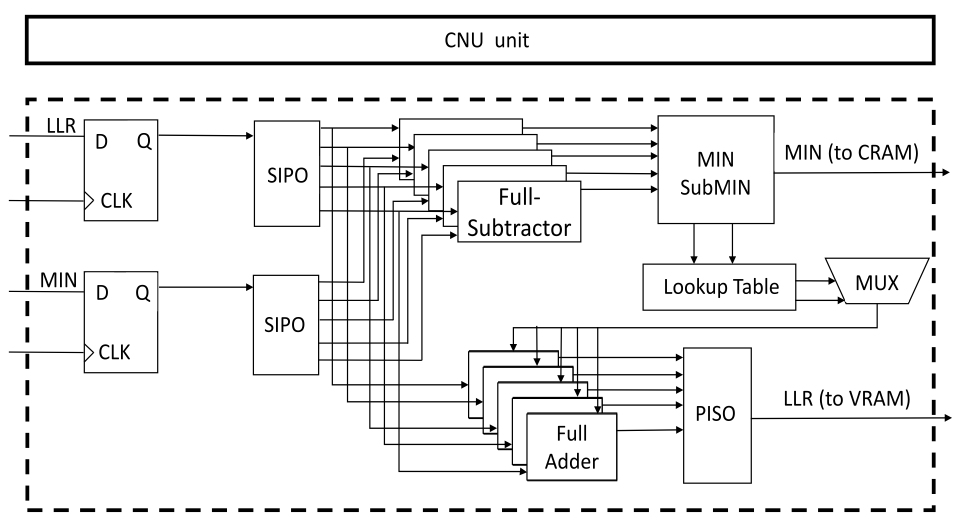
Turning an error correcting code into a real chip requires simplifying the math so it can run with limited hardware precision, without giving up too much performance. This project develops quasi cyclic LDPC codes that are easy to encode with simple shift register circuits, along with analysis tools that predict how a decoder will behave once its internal messages are rounded to a fixed number of bits. The group also builds and tests real decoder and encoder hardware, including circuits tuned for medical applications like heart rhythm monitoring.
This work produced performance bounds and design techniques now used to build efficient, low power LDPC hardware, plus a wearable sensor decoder that keeps over 99 percent classification accuracy even when a fifth of the incoming sensor data is corrupted.
- H. Hatami, D. G. M. Mitchell, D. J. Costello, Jr., and T. Fuja, "A Threshold-Based Min-Sum Algorithm to Lower the Error Floors of Quantized LDPC Decoders," IEEE Transactions on Communications, vol. 68, no. 4, pp. 2005-2015, Apr. 2020.
- D. G. M. Mitchell and Y. Liu*, "Efficient Implementation of a Threshold Modified Min-Sum Algorithm for Low-Density Parity-Check Decoders," U.S. Patent No. 11,309,915, issued April 2022.
- Y. Liu*, X. Tang, D. G. M. Mitchell, and W. Tang, "Ternary LDPC Error Correction for Arrhythmia Classification in Wireless Wearable Electrocardiogram Sensors," IEEE Transactions on Circuits and Systems I, vol. 69, no. 1, pp. 38-400, Jan. 2022.
Robust Error Control for Time-Varying Channels
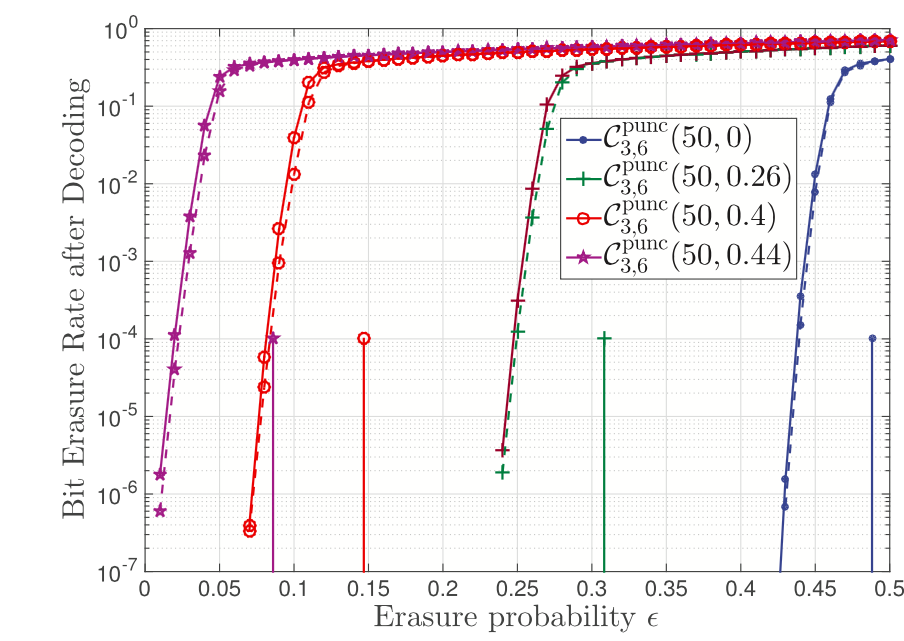
Wireless and other communication links do not stay the same quality over time, so a single fixed error correcting code is rarely the best choice throughout a connection. This project studies puncturing, a technique that lets one code adapt to multiple transmission rates by selectively withholding some coded symbols, and works out exactly what makes a code well suited to this kind of adaptation.
The group derived a simple mathematical rule that predicts how well an LDPC code will perform after puncturing, and used it to design codes that stay reliable across a wide range of rates, useful for links where channel quality changes during a single connection.
- D. G. M. Mitchell, M. Lentmaier, A. E. Pusane, and D. J. Costello, Jr., "Randomly Punctured LDPC Codes," IEEE Journal on Selected Areas in Communications, vol. 34, no. 2, pp. 408-421, Feb. 2016.
- H. Zhou, D. G. M. Mitchell, N. Goertz, and D. J. Costello, Jr., "Robust Rate-Compatible Punctured LDPC Convolutional Codes," IEEE Transactions on Communications, vol. 61, no. 11, pp. 4428-4439, Nov. 2013.
High-rate Coupled Turbo/LDPC Codes for Optical/Streaming Applications
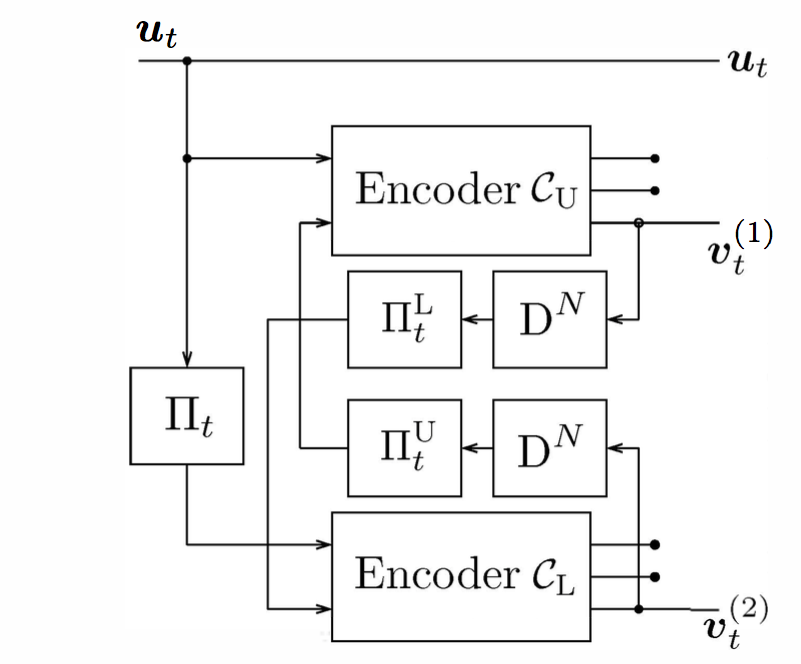
High speed optical networks need error correcting codes that run at very high code rates with hardware efficient decoding. This project studies braided convolutional codes, a family related to turbo codes where two encoders feed outputs into each other over time, and shows they perform well even close to the noise floor while tolerating the kind of rate adjustment optical systems need.
These braided codes match or beat other high rate code families proposed for optical communication while reusing decoding hardware similar to turbo codes, making them a practical option for next generation high speed optical links.
- M. Zhu, D. G. M. Mitchell, M. Lentmaier, and D. J. Costello, Jr., "Error Propagation Mitigation in Sliding Window Decoding of Braided Convolutional Codes," IEEE Transactions on Communications, vol. 68, no. 11, pp. 6683-6698, Nov. 2020.
- M. Zhu, D. G. M. Mitchell, M. Lentmaier, D. J. Costello, Jr., and B. Bai, "Braided Convolutional Codes with Sliding Window Decoding," IEEE Transactions on Communications, vol. 65, no. 9, pp. 3645-3658, Sept. 2017.
Acknowledgements
The research described above is based upon work supported in part by the National Science Foundation under Grant Nos. CCF-2145917, CCSS-1710920, CCF-1161754, OIA-1757207, and HRD-1914635, and in part by the National Aeronautics and Space Administration (NASA) Training Grant NNX15AL51H.